- Your cart is empty Browse Shop
The crop is ready. Is the trade chain?
By Newton Freeman | Xcado, Nairobi | June 2026
There is a quiet revolution growing in Kenya’s cool highlands. From the slopes of the Aberdares to Nyandarua County, farmers are harvesting one of the most globally coveted fruits; the strawberry. And they’re doing it efficiently, profitably, and at scale. Yet for all that potential, most of this fruit never reaches the premium buyers willing to pay the most for it. That gap between what farmers grow and what the world will pay is precisely what Xcado was built to close.


The Agronomic Case: Why Kenya’s Highlands Grow Export-Quality Strawberries
Kenya’s highland regions — operating between 1,500 and 2,800 metres above sea level — offer near-perfect conditions for commercial strawberry cultivation. Temperatures of 15°C–25°C, reliable rainfall, and rich volcanic soils produce fruit with exceptional colour, sweetness, and shelf integrity. These are not incidental factors — they are competitive moats.
On the production economics, the numbers speak with authority. An acre of well-managed strawberry land planted with 15,000–20,000 runners yields between 5,000 and 10,000 kg annually. At prevailing farmgate prices of Ksh 300–600 per kg, a single acre can generate Ksh 1.5M to Ksh 6M per year — figures that dwarf traditional smallholder crops. Even at 1/8-acre scale, a disciplined farmer earns Ksh 40,000 to Ksh 100,000 monthly. Setup costs per acre — seedlings, irrigation, mulch, and bed infrastructure — run between Ksh 200,000 and Ksh 400,000. In most scenarios, payback occurs within the first season.
“An acre can produce up to 8 tonnes per season. Even a small 1/8-acre plot can bring in over Ksh 300,000 in approximately 90 days — and the plant bears fruit for up to five years.”
The Export Opportunity: Premium Markets Are Paying Premium Prices
Kenya’s strawberry export footprint is modest today — but precisely that fact makes it a strategic opening, not a limitation. The destination markets are defined, the demand is growing, and the price differentials are dramatic.

The UK is Kenya’s anchor export market for strawberries — and with wholesale prices exceeding $10 per kg in Western markets, the value-capture potential of a reliable, certified export channel is enormous. Qatar and the Gulf represent fast-growing secondary destinations where the Kenyan production window (year-round due to elevation cycling) aligns perfectly with periods of high regional demand. Hong Kong SAR has emerged as a third destination — a gateway to broader Asian premium retail.
The average Kenya strawberry export price reached $6,198 per tonne in 2024, a 15% increase year-on-year. The direction of travel is clear.
The Problem Xcado Is Solving
Despite this extraordinary backdrop, Kenya’s strawberry export volume remains a fraction of its agronomic potential. The reasons are structural — and well known to anyone who has tried to navigate the system.
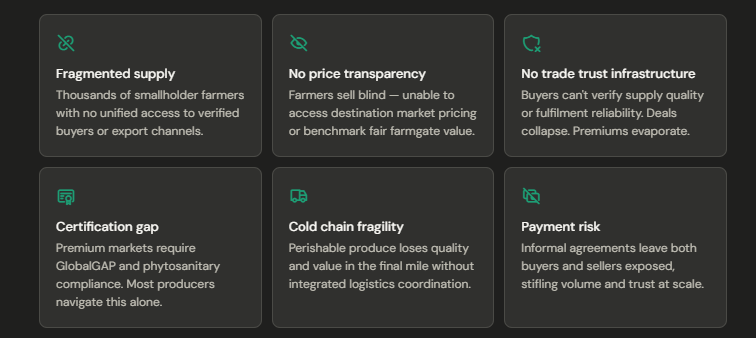
Each of these problems individually is solvable. Together, they constitute a system failure — one that leaves Kenyan strawberry farmers earning a fraction of what their product commands at destination. Xcado is designed to dissolve every single one of them.
The Xcado Solution: Digital Trade Infrastructure for Real Produce
Xcado is not a marketplace in the conventional sense. It is a structured digital agro-trade platform — built for the specific dynamics of East African agricultural exports. For strawberry trade, the platform operates as a complete transaction layer: verified supplier profiles, real-time price benchmarking, escrow-backed payment settlement, quality certification tracking, and logistics coordination — all in one place.

The Xcado Certified quality mark provides the export-grade quality signal that premium buyers require. The platform’s escrow architecture removes payment risk on both sides of the transaction. And the structured county-level supply aggregation model means a buyer in Doha or London can confidently place a forward order — knowing the supply chain behind it has been digitally verified.
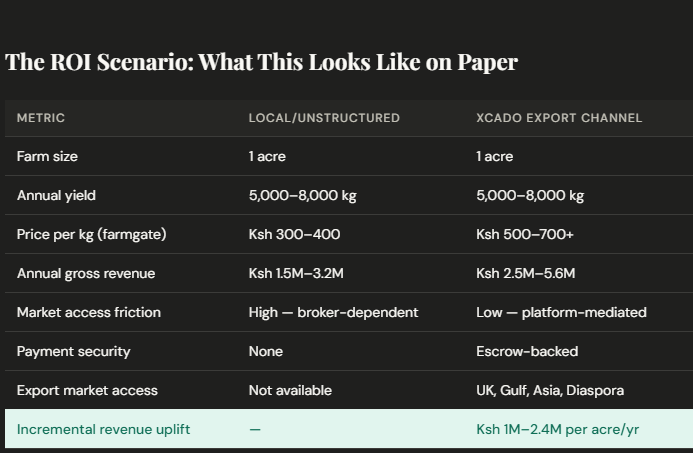
The ROI Scenario: What This Looks Like on Paper