

To the Mothers Who Feed Nations
A Mother’s Day reflection from XCADO Group on the women who tend Kenya’s soil — and what we’re building to back them.
This morning, before most of Kenya stirred, a woman in Nyandarua was already in her field. Another in Kirinyaga was picking the last of the season’s avocados by torchlight, careful not to bruise the skin. In Meru, a SACCO member was loading mangoes into a crate destined for a processor in Mombasa, then onward to Dubai. None of them were thinking about Mother’s Day. They were thinking about the harvest — about whether the rains would hold, whether the buyer would honour the price, whether the school fees would come through this term.
This is what feeding a nation looks like before sunrise.
Today is Mother’s Day. At XCADO Group, we wanted to mark it not with sentiment alone, but with recognition — of where Kenya’s food actually comes from, of whose hands it passes through first, and of what we owe to the people who carry the country on their backs while raising the next generation.
The hidden architecture of every harvest
When you buy a Kenyan avocado in London, a packet of French beans in Amsterdam, a tray of mangoes in Riyadh — there is a long, mostly invisible chain of decisions that brought it to your hand. Cold storage. Phytosanitary inspection. A KEPHIS certificate. A bill of lading. A buyer who paid on time.
What is even more invisible is the chain before the chain. The woman who chose this variety because it travels better. The grandmother who walked four hours to a cooperative meeting because the SACCO chairperson said there might be a new buyer worth listening to. The mother who decided not to send the produce to the village market this week because there was a better price further away — and who absorbed the risk of that decision alone.
Every export crate from Kenya carries a story like that. Every supermarket shelf in a foreign capital is built on someone’s quiet labour at home.
What XCADO is building
We started XCADO Group because we believe Kenya’s agricultural produce — and the people who grow it — deserve a path to global markets that doesn’t dilute the value at every step. That belief leads to two parallel commitments.
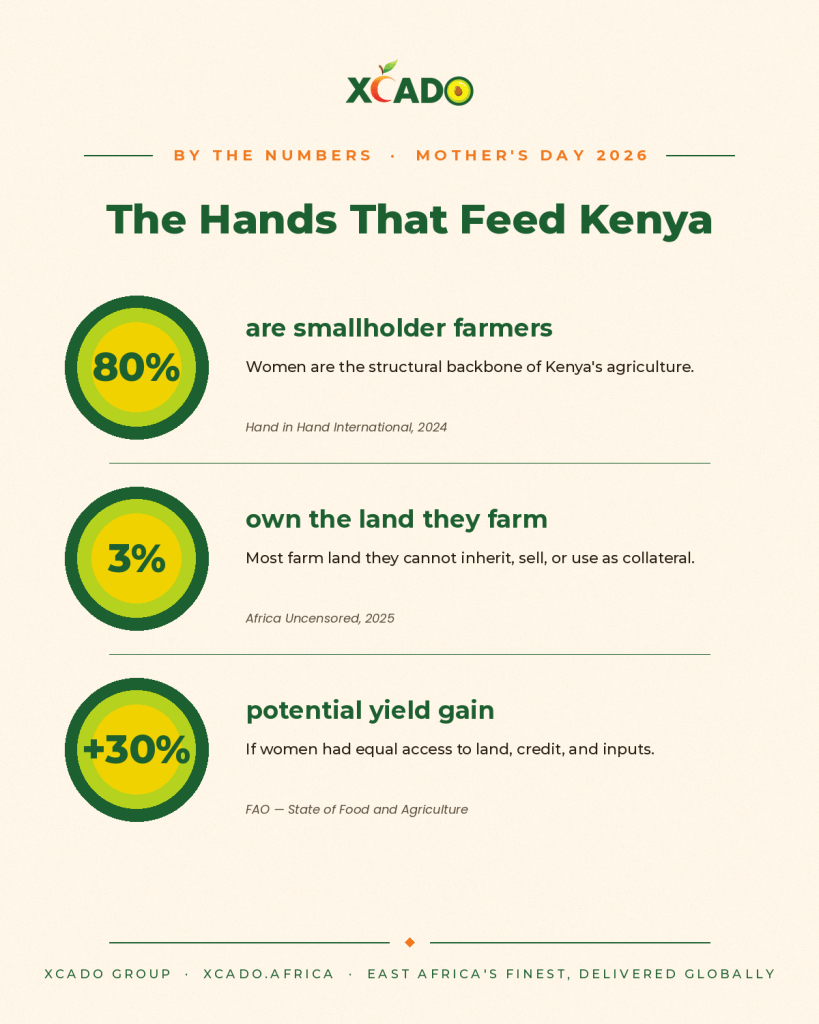
The first is XGROW, our farm management platform for smallholders, cooperatives, and SACCOs. The majority of our future users will be women, because the majority of Kenya’s smallholders are women. We are building it with that in mind: with attention to the realities of how women actually farm, market, and decide.
The second is the Xcado B2B platform, which connects county-level processors directly to international buyers. We want the woman in Meru loading those mangoes to know — and to be able to see — that the people on the other end of the chain know who she is and what she has done.
Neither of these is charity. They are infrastructure. The thesis is straightforward: when you give women farmers the tools, the visibility, and the negotiating position that men have long had by default, the entire system gets stronger. Yields rise. Households eat better. Children stay in school. Communities hold together.
That is not only an act of fairness. It is the most pragmatic agricultural policy this continent could write.
A day of honour, a year of work
To every woman who tended a Kenyan field this morning before her household woke — thank you.
To every mother whose children eat because of crops she herself planted — thank you.
To every grandmother whose name is on no title deed but whose labour is in every export — we see you, and we are building for you.
Happy Mother’s Day from all of us at XCADO. The work of honouring you does not end today. It begins again tomorrow morning, before the sun.
— The Xcado Family
Nakuru, Kenya · 10 May 2026